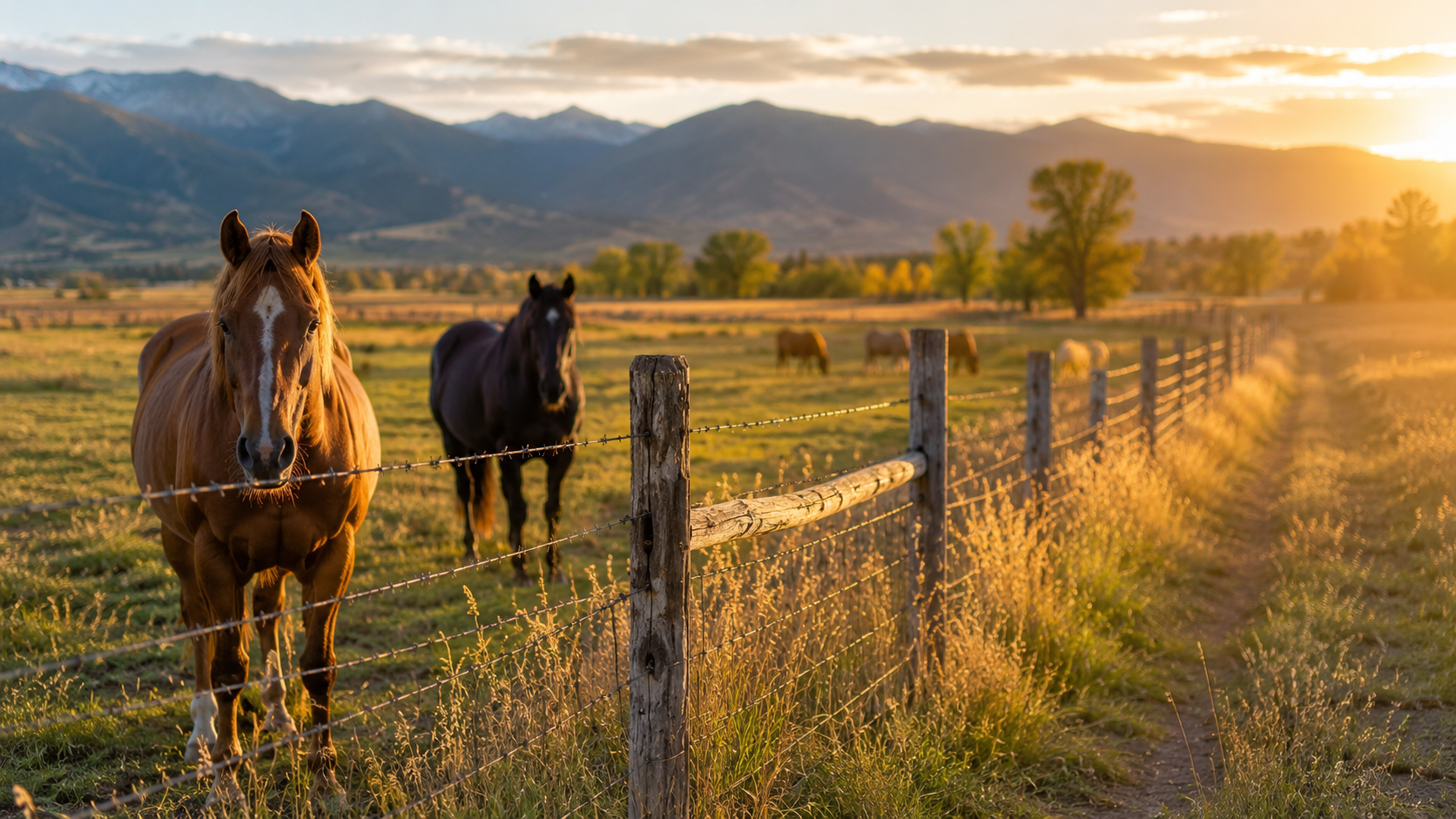

If you own horses, cattle, or other livestock in Colorado, there is one piece of state law that often surprises newer landowners:
Colorado is generally considered a “fence-out” state.
That does not mean livestock owners can simply ignore escaped animals or allow them to wander wherever they want. It does mean, however, that Colorado’s fence laws place much of the responsibility on neighboring landowners to maintain a lawful fence if they want to keep livestock off their property.
The concept dates back to Colorado’s long agricultural history and remains part of state law today.
What Does “Fence Out” Mean?
In a fence-in state, livestock owners are generally expected to keep their animals enclosed on their own property.
Colorado approaches the issue differently.
Under Colorado’s fence statute, a landowner who wants legal protection from livestock trespass generally needs to maintain a lawful fence in good repair. If livestock break through that lawful fence and damage grass, crops, gardens, or other property, the landowner may be able to recover damages from the livestock owner.
This is why Colorado is commonly described as a fence-out state.
You may also hear people refer to Colorado as an “open range” state. The Colorado Department of Agriculture notes that “open range” is really a description of land use rather than the name of a specific law. The actual legal framework comes from Colorado’s fence statutes, particularly C.R.S. § 35-46-102.
What Is Considered a “Lawful Fence”?
Colorado law specifically defines a lawful fence.
Traditionally, that means a well-constructed three-strand barbed-wire fence with substantial posts spaced approximately 20 feet apart, sufficient to contain ordinary horses and cattle, with gates of comparable quality.
The statute also allows other types of fencing that provide similar effectiveness, so a lawful fence is not necessarily limited to barbed wire.
The key takeaway is that the fence must be:
- Properly constructed
- Sufficient to turn ordinary livestock
- Maintained in good repair
- Accompanied by gates that are equally secure
A broken fence, poorly maintained section, or open gate can significantly affect whether a property owner has recourse under the fence statute.
What Animals Does This Apply To?
This is an important distinction.
Colorado’s fence statute applies specifically to livestock.
Under C.R.S. § 35-46-101, livestock includes:
- Horses
- Cattle
- Mules
- Asses
- Goats
- Sheep
- Swine
- Buffalo
- Cattalo
The law does not automatically apply to household pets or every other type of animal unless another law specifically says otherwise.
So when discussing Colorado as a “fence-out state,” we are primarily talking about livestock law, not dogs, cats, or other companion animals.
Does That Mean Livestock Owners Have No Responsibility?
No.
This is where the fence-out concept is often misunderstood.
Colorado law does not give livestock owners unlimited permission to let animals roam wherever they want.
For example, livestock owners can still be liable if they place too many animals on land that cannot properly support or water them and those animals move onto neighboring property seeking forage or water. The law also allows civil remedies when livestock are intentionally or recklessly allowed to trespass.
There are also separate rules regarding livestock on roads, highways, and in municipalities. Colorado law prohibits knowingly allowing livestock to run at large in certain public areas when a sufficient barrier separates the livestock from those areas.
So “fence out” should not be interpreted as “livestock owners have no responsibility.”
What If Livestock Show Up on Your Property?
In most situations, the simplest solution is also the best one.
If you know who owns the animals, contact the owner as soon as possible. Most horse and livestock owners want escaped animals returned quickly and safely.
If you do not know who owns them, the Colorado Department of Agriculture recommends contacting a brand inspector.
Colorado law can allow a property owner to temporarily take livestock into custody in certain situations, but doing so also creates responsibilities. The person taking custody must reasonably care for and feed the animals and may have additional notification requirements.
When in doubt, contacting law enforcement, your county sheriff, or a Colorado brand inspector is usually a safer first step than attempting to handle unfamiliar livestock yourself.
What About Fences Between Neighboring Agricultural Properties?
Colorado law also addresses partition fences between adjoining agricultural or grazing properties.
Generally, when agricultural or grazing lands share a boundary, each property owner has responsibility for a portion of the boundary fence, and costs for construction and maintenance may be shared unless the owners agree otherwise.
This is one of those situations where communication between neighbors can prevent a great deal of frustration later.
Roads and Towns Are Different
Colorado’s general fence-out rules should not be confused with laws governing livestock around roadways and populated areas.
Separate statutes address livestock running at large on public roads, highways, municipalities, and areas surrounding towns and cities.
In other words, seeing cattle grazing on open range in a rural area is very different legally from knowingly allowing livestock to wander down a public highway.
Good Fences Still Make Good Neighbors
Even though Colorado is a fence-out state, most livestock owners do everything possible to keep their animals safely contained.
Good management includes:
- Regularly inspecting fences and gates
- Providing adequate forage and water
- Quickly retrieving escaped livestock
- Communicating with neighboring property owners
- Working together on shared boundary fencing when appropriate
Those practices protect livestock, property, drivers, and relationships between neighbors.
The Bottom Line
Colorado’s fence laws reflect the state’s long agricultural history.
In general, landowners who want to keep livestock off their property are responsible for maintaining a lawful fence, and that fence can affect whether they are able to recover damages if livestock enter and damage their property.
But the law is more nuanced than simply saying livestock are allowed to roam freely.
Different rules can apply depending on where the animals are located, whether a lawful fence exists, whether the livestock owner acted knowingly or recklessly, and whether roads, municipalities, or other special circumstances are involved.
Most importantly, these laws relate specifically to livestock and should not automatically be assumed to apply to pets or other animals.
Want to Learn More?
For horse and livestock owners who want to dig deeper, these are excellent places to start:
Colorado Department of Agriculture — Open Range and Fencing
https://ag.colorado.gov/brands/open-range-and-fencing
Colorado Department of Agriculture — Colorado Revised Statutes for Livestock and Fencing
https://ag.colorado.gov/colorado-revised-statutes
Official Colorado Revised Statutes through LexisNexis
https://www.lexisnexis.com/hottopics/colorado
C.R.S. § 35-46-102 — Owner May Recover for Trespass
https://advance.lexis.com/documentpage/?pdmfid=1000516&crid=ef277c19-2d48-4a4b-b9ba-af4a6e21943a&config=014FJAAyNGJkY2Y4Zi1mNjgyLTRkN2YtYmE4OS03NTYzNzYzOTg0OGEKAFBvZENhdGFsb2d592qv2Kywlf8caKqYROP5&pddocfullpath=%2Fshared%2Fdocument%2Fstatutes-legislation%2Furn%3AcontentItem%3A61P5-WXR1-DYDC-J3X1-00008-00&pdcontentcomponentid=234176&pdteaserkey=sr0&pditab=allpods&ecomp=6s65kkk&earg=sr0&prid=40eb5563-cb19-4fcd-bc81-165649c9a9d9
Colorado State University Extension — Fencing Resources
https://extension.colostate.edu/resource/fencing/
This article is intended for general educational purposes only and does not constitute legal advice. Colorado statutes and local regulations can change, and individual circumstances may affect how the law applies. Consult a qualified Colorado attorney or appropriate state or local agency for guidance regarding a specific situation.

Author: Una
Una moved to Colorado in 2007 and started the Colorado Horse Forum as a way to meet other equestrians in the area. Una now rides and competes in dressage. She operates a small dressage horse breeding program in Castle Rock.


Leave a Reply
You must be logged in to post a comment.